Thursday, April 4, 2013

Comodoro Zone Interviews


The Comodoro Zone

The La Prensa District

Los Kilometros 

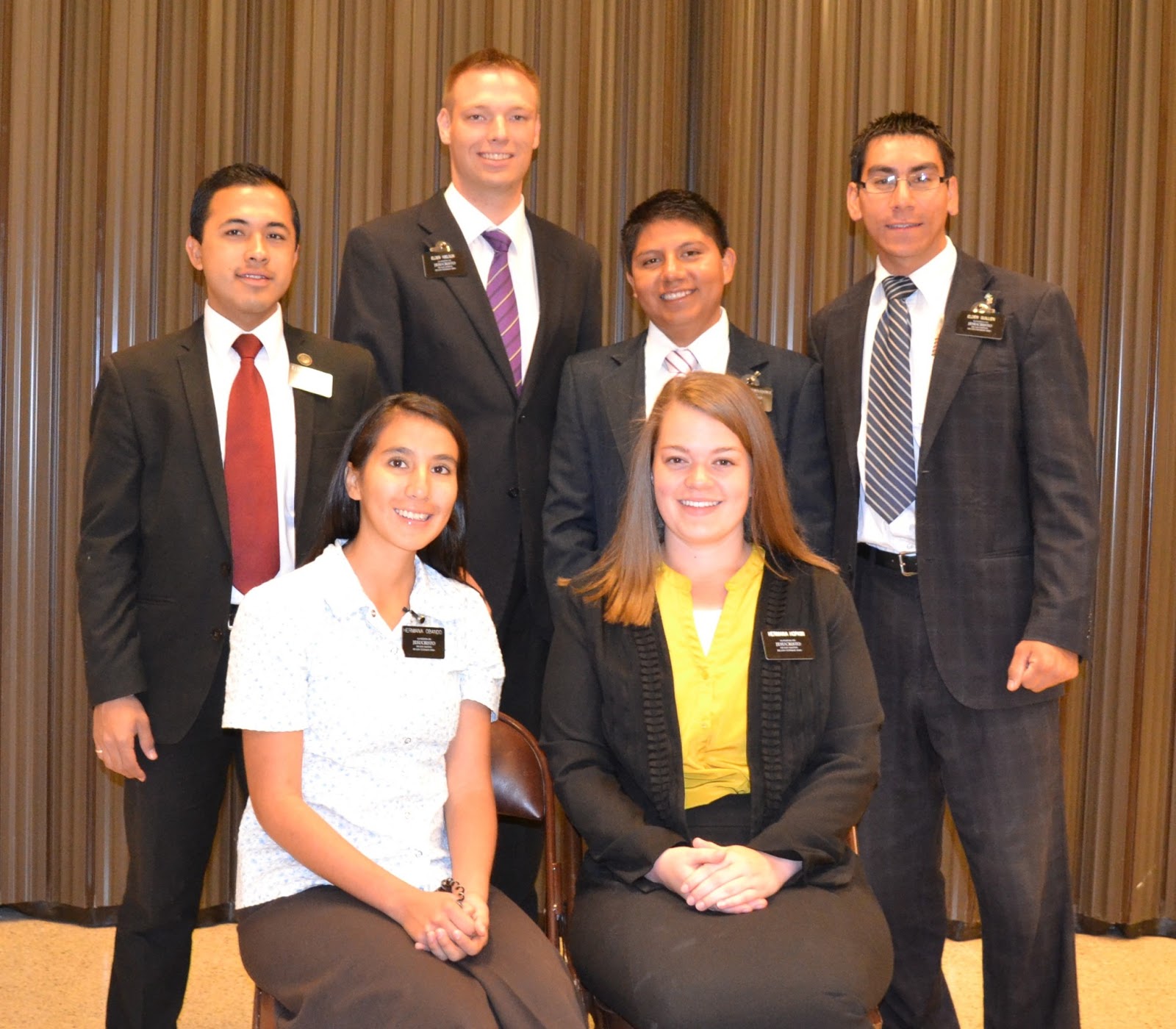
The District Leaders 

The Zone Leaders 

Bariloche Zone Interviews

 We did the interviews for the Bariloche Zone in three different places as we drove along the mission tour.  This makes it so the missionaries don't need to spend an entire day traveling to their interviews and then back to their districts.  It is four hours from Esquel to Bariloche and they are in the same zone!


President and Hermana Asbell are in the Esquel District.  They are the "Matrimonial Couple" that just arrived here in the mission!  We are so grateful for them!  President Asbell is now the Branch President in the Trevelin Branch. There are usually between ten to maybe eighteen members that attend in that branch.  They have a beautiful building there in Trevelin and good things are already happening!


The rest of the Esquel District


The El Bolson District 


The Bariloche District 


The District Leaders


The Zone Leaders

Zapala Zone Interviews

We stopped in San Martin so the San Martin District would not have to travel to Zapala for interviews. Because of that their zone pictures are in two separate groups.


The San Martin District


The rest of the Zapala Zone


The Zapala Centro District 
 Two of the areas in this district are closed right now as we wait for missionaries to arrive! 


The Aeropuerto District


The District Leaders


The Zone Leaders

Standard of Excellence


Friends of the Zapala Zone!

April Zone Leader Council


We are so grateful for our wonderful Zone Leaders.  They are especially important because the mission is so large and they are the ones that are right there and know the needs of the zone.    They do a wonderful job in taking care of their zones! They work hard to make a difference in the lives the missionaries in their zones and to further the missionary work in the wards and stake that makes up their zones.
 
They came prepared to discuss the talk "Do Things That Make a Difference" by Elder M. Russell Ballard.  They also discussed how to care for one another better.  Each Zone Leader Companionship was able to teach lesson one and give feedback to each other. Some other things that were discussed were ways to make district meetings more productive, communications among the missionaries and how to be excellent.

Tuesday, April 2, 2013

Adjusted Missionary Email Policy

This is the Notification we just received from the church about the adjusted Missionary email Policy:
 
"Missionaries are to write to their families each week and are also authorized to communicate by email with friends, priesthood leaders, and new converts.  Mission presidents should allow sufficient time on preparation day for missionaries to write emails and letters.  While in the mission field, missionaries should receive authorization from the mission president before entering into communication, including via email, with converts and others of the opposite gender within the mission boundaries."
 
President Lovell has extended the time the missionaries have for using computers to write letters.  It is now seventy minutes each preparation day.

 
There are guidelines for using the internet and computers.  One of them is to be near  your companion in the "cyber" to protect each other from the temptation of breaking the mission rules.    While we were on the Mission Tour for two weeks the assistants did not had time to e-mail their families.  President Lovell gave them permission to use our computers to let their families know they were safe and doing well.  When we walked into the lobby we found them keeping all of the computer rules.  Our missionaries find that obedience always brings blessings!

Saturday, March 23, 2013

Mission President's Seminar in Buenos Aires

President Lovell and I are looking forward to the Mission President´s Seminar in April.  I was thinking about the amazing experience we had at the Mission President´s Seminar last October and decided to share a few of the experiences and pictures from the seminar with you.  All of the Mission Presidents and their wives were there from the South American South Area of the Church.  This includes all of the missions in Chile, Argentina, Uruguay and Paraguay.  We were so blessed to have Elder Oaks and Elder Bednar and their wives along with the South America South Area Presidency there to teach us.  

It was very fun to get to know the other Mission Presidents and their wives.  We were able to share ideas with each other.  Some had been out for two years, some one year and about one third of us had only been out for a few months.


When we met President and Sister Levrino, President of the Salta Mission, we told them our niece Lexie had just received her call to their mission a few weeks before the seminar.  It was fun letting them know what a wonderful Hermana Lexie would be!


Elder Oaks and Elder Bednar and their wives were so kind and seemed to enjoy meeting and talking with all of us.


This is a picture of all of the mission presidents and their wives.


For each of the meals that were served, we had place cards to tell us each where to sit.   On the last evening we were excited to see that our place cards were right next to Elder and Sister Bednar´s place cards. It was such a privilege to be with them. They were so wonderful and were willing to answer our many questions.  The spirit was very strong and we felt a witness that this was an apostle of the Lord Jesus Christ.


Later that night we had the privilege to attend a wonderful presentation about the life of Joseph Smith done by musicians in the area.   It was an amazing evening!  Elder Oaks also attended and thanked the performers for their beautiful music.


It was written and conducted by these two talented musicians.  It was fun to hear their story.  During the time they spent together preparing and practicing this performance they fell in love and were married  in the Buenos Aires Temple just a short time before the performance we watched.


One of the highlights of the evening was meeting these two wonderful performers, Damian and Nicolas  Rosas.  Their sister Hermana Rosas was an Hermana in our mission.  Nicolas played the part of Joseph and Damian  played the part of Alvin in the performance.  They knew that we would be there that evening and found us after the performance with special letters to deliver to our mission! We felt an immediate bond to these wonderful brothers!


We were so excited to meet President and Sister Humphrey of the Chile Concepcion Mission.  Our daughter Ashley is a missionary in their mission.


We were able to attend the newly rededicated Buenos Aries Temple in a session with Elder Oaks.  


After the temple session, we walked over to eat lunch at the CCM - the MTC in Buenos Aires.

¨¨

We sat across from Elder and Sister Oaks and next to Elder and Sister Bednar. Elder Oaks is sitting here next to President and Sister Carter of the Buenos Aires West Mission.  It was so fun to get to know the Carters.  They were willing to share things that have worked well for them in their mission, and I learned a lot about how to do a blog from Sister Carter.


After lunch we were able to go upstairs and meet some of the missionaries at the CCM that were preparing to come to our mission.


Just before we got on the shuttle to take us to the airport we saw Hermana Clair and her little daughter Crystal from the Catrial Branch in our mission.  She and her husband were there attending the temple.  What a great ending to a wonderful week!

Friday, March 22, 2013

What's in a Name?

periodic%20table


The country of Argentina was actually named after an element in Periodic Table, Argentum, #47. It happened something like this:


In the early 1500’s, because of a shipwreck, Spaniards landed here. They decided they better give some gifts to the local people to endear themselves, and they offered silver. The local people basically said thanks, but we have plenty of silver. Oh really? Can you show us where? And they went and saw. Not too much later, this group went back to Spain with the news that there was plenty of silver for the taking. They named the river where they originally landed, the River of Silver (Rio de la Plata) and called the country Argentina derived from argentum, the Latin word for silver. As it turns out Argentina does not actually mine that much silver, in fact, it is clear down the list at #15.

Top 20 Silver Producing Countries in 2006
(millions of ounces)
1. Peru 111.6
2. Mexico 96.4
3. China 75.4
4. Australia 55.6
5. Chile 51.5
6. Poland 40.4
7. Russia 39.6
8. United States 36.7
9. Canada 31.2
10. Kazakhstan 26.1
11. Bolivia 15.2
12. Sweden 8.6
13. Indonesia 7.7
14. Morocco 7.6
15. Argentina 6.1
16. Turkey 6.0
17. Iran 3.2
18. South Africa 2.8
19. India 2.7
20. Uzbekistan 2.3

crescent moonHowever, as a minor point of interest, there is a picture associated with argentum. It is a picture of the crescent moon. Between medialunas and how the Argentines love night life, in one way or the other, I think it has turned out to be appropriate. Of course, we don’t know where the locals took the shipwrecked Spaniards to see the silver. We do know that silver has been mined in the Andes Mountains since the days of the Incas. The largest of those mines in Argentina is the Capillitas Mine which is found at about 10,000 feet. As you can imagine, it is not worked year round. minemine2Vista Capillitas Torregm-rhdchrst-argntn-03
SantaRitaThe Incas held a tradition that the blood of their rulers was turned to stone, and the stone was called Inca Rosa. These stones grew in the mine as stalactites and stalagmites. Then, about 150 years ago, people began to use the beauty of Inca Rosa and mine for it, specifically. It was discovered, during that era, that there are over 100 types of precious stones inside the Capillitas Mine.
capillitas2They are among the most beautiful and rare in the world. Interestingly, many of the stones were found among the debris of the silver veins.


m526-2-w52908
Rhodochrosite is the official name for Inca Rosa and is found in several places in the world, however, only in Capillitas Mine, in Argentina, can you find the banded stones, with colors ranging from almost white to rich pink to brown. When the bandings show a distinct chocolate brown color, it is called a capillite.
capillitas3
Although the mine has been mapped, its excavation has not been well-documented and it is thought that perhaps the story of Inca Rosa/Rhodochrosite like the story of Argentina itself, has not completely unfolded.

http://buenosaireswest.blogspot.com.ar/2012/09/whats-in-name.html